
When it comes to B2B sales, few terms are as misunderstood as sales funnel and sales pipeline. Many people use them interchangeably, yet they represent two very different perspectives on the buying journey. Knowing the difference—and how to use both—can transform the way you generate, nurture, and close leads.
What Exactly Is a Sales Funnel?
The funnel is all about the customer’s journey. It maps the path a prospect takes from discovering your business to deciding whether or not to buy. At the top sits awareness, where potential buyers first encounter your solution. From there, they move into consideration and evaluation before finally reaching the decision stage at the bottom.
The value of a funnel lies in its ability to show you where prospects drop off. If plenty of people discover your brand but few move into consideration, it’s a sign your message isn’t resonating. If you’re strong at generating interest but weak at closing, the problem might lie in how you position your value proposition. In short, the funnel gives you a conversion snapshot through the eyes of your buyer.
What About the Sales Pipeline?
The pipeline flips the perspective. Instead of focusing on the customer, it focuses on your team’s actions to progress deals. Think of it as an internal workflow, with stages like prospecting, qualification, proposal, negotiation, and closing. Each stage represents specific tasks that must be completed before a deal advances.
For sales managers, pipelines are invaluable. They make revenue forecasting possible, highlight bottlenecks, and show how quickly deals are moving—or stalling—through the process. A healthy pipeline means a predictable business, something every sales leader strives for.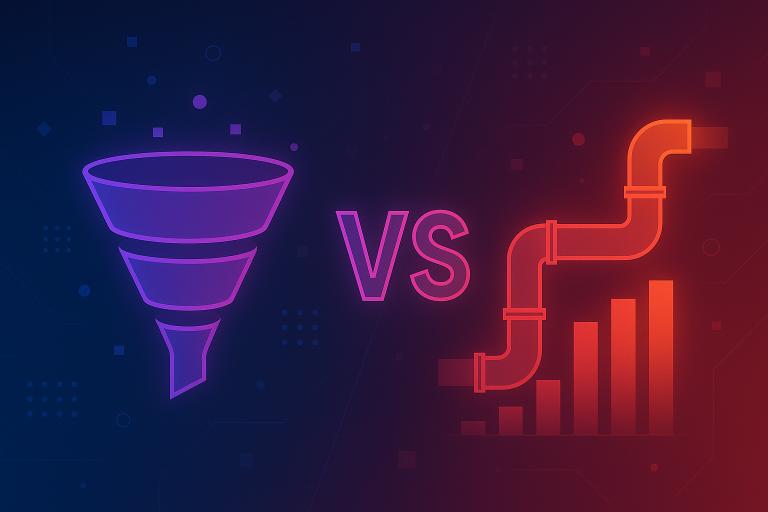
The Key Difference
At its core, the funnel measures customer behaviour while the pipeline measures sales activity. Funnels tell you how well you’re engaging prospects and where interest fades. Pipelines tell you how effectively your team is moving deals forward. One is outward-looking, the other inward-looking—but together, they paint a full picture.
Why You Need Both
Modern B2B companies rarely succeed by focusing on one framework alone. Marketing teams tend to live in the funnel, refining campaigns that attract and nurture prospects. Sales teams operate in the pipeline, advancing qualified opportunities towards a close. When both systems are aligned, the handover from marketing to sales becomes seamless, and performance across the whole journey improves.
This integration is where prospecting strategies shine. A well-timed email campaign feeds the funnel with new leads. LinkedIn engagement nurtures them through the middle stages. Cold calling and targeted follow-ups push the most qualified opportunities further down the pipeline. And with website visitor identification tools, you can spot prospects earlier than ever, creating smoother transitions from interest to action.
Optimising Funnels and Pipelines
Improvement starts with visibility. Map out your real buyer journey, then compare it to your funnel to see where conversions dip. Address gaps with tailored content—educational resources for early awareness, case studies for evaluation, and ROI-driven messaging for decision-makers.
On the pipeline side, hold regular reviews to keep deals moving. Establish clear criteria for advancing prospects so your stages don’t get clogged. Track data like deal velocity, average size, and win rates, then forecast based on actual patterns rather than guesswork. Automation tools can help by maintaining steady follow-up and ensuring no opportunity slips through unnoticed.
The Bigger Picture
The funnel and pipeline aren’t rivals—they’re complementary. Funnels reveal how effectively you attract and nurture prospects, while pipelines show how efficiently you convert them into revenue. Companies that combine both frameworks gain control over the entire customer journey, from first touch to final signature.
In today’s competitive B2B environment, understanding and integrating these two systems isn’t just useful—it’s essential for growth.

